Georsgis Blog

↑ Grab this Headline Animator

Showing posts with label Disaster Management Book. Show all posts

Monday, 15 April 2019

Geographic Information Systems (GIS) for Disaster Management


Preface of the Book
This book was primarily written for disaster management students interested in learning about the many facets of Geographic Information Systems (GIS) for disaster management.
The unfortunate reality is that disasters will continue to proliferate in size, scope, and intensity. Future disasters will affect more people in diverse geographical contexts. Given that disasters are fundamentally spatial in nature, GIS plays a critical role in disaster management. However, there is an educational challenge and workforce need for well-educated practitioners and specialists who have a comprehensive, interdisciplinary understanding of the conceptual, technological, analytical, and representational capacities of GIS, as well as the policy and practice of disaster management. My hope is that this book can meet these challenges, even if partially. 

Tuesday, 19 February 2019

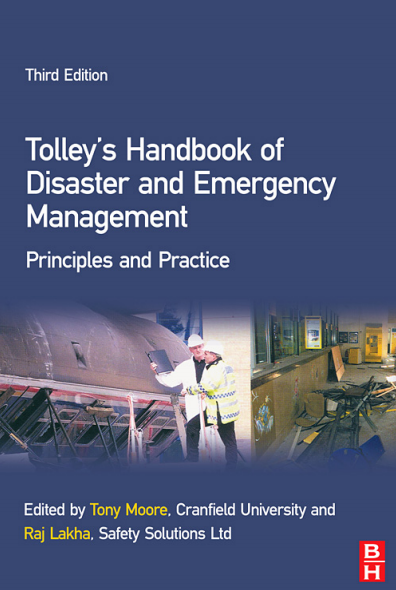
Handbook of Disaster and Emergency Management

Preface-Tolley’s Handbook of Disaster and Emergency Management: Principles and Practice has been produced to assist those who are either directly or peripatetically engaged in Disaster or Emergency Management issues. 


Handbook of Disaster and Emergency Management


In the broadest context the Handbook will be of use to those in Occupational Safety and Health, Emergency Planning, COMAH operations, Civil Defense, Business Continuity and Insurance, Loss Prevention, Risk Management, Fire Safety, Public Health and Environmental Management. It is relevant to both the private and the public sectors. The publication will also be of interest to practitioners in countries which have a similar approach to that of the UK because of the inclusion of information and case studies relevant to all those with responsibility for Crisis, Disaster and Emergency Management.

Monday, 4 February 2019

Disaster Management -A Disaster Manager’s Handbook


Foreword


Most of the world’s natural disasters occur in Asia and the Pacific. They cause enormous destruction and human suffering in the Asian Development Bank’s (ADB) developing member countries (DMCs). Environmental degradation, which is often a result of economic development and associated human settlement patterns that ignore appropriate resource management, can increase a country’s vulnerability to natural hazards and exacerbate the impacts. As a development institution, ADB is quite concerned about the rising incidence and impact of natural disasters in Asia and the Pacific region.


Sunday, 27 January 2019

Advancing Culture of Living with Landslides -Volume 1


ISDR-ICL Sendai Partnerships 2015–2025
Kyoji Sassa • Matjaž Mikoš Yueping Yin, Editors

Foreword

Landslides are a serious geological hazard. Among the host of natural triggers are intense rainfall, flooding, earthquakes or volcanic eruption, and coastal erosion caused by storms that are all too often tied to the El Niño phenomenon. Human triggers including deforestation, irrigation or pipe leakage, and mining spoil piles, or stream and ocean current alteration can also spark landslides. Landslides occur worldwide but certain regions are particularly susceptible. The UN’s Food and Agriculture Organization underlines that steep terrain, vulnerable soils, heavy rainfall, and earthquake activity make large parts of Asia highly susceptible to landslides. Other hotspots include Central, South, and Northwestern America.

Sunday, 20 January 2019

Book: Disaster Management Hand Book


Book: Disaster Management Hand Book
Download Link

http://bit.ly/2QQYw9N

Contact us

Name

Email *

Message *

Follow us on Facebook and YouTube